Most local service businesses do not have a tool problem. They have separate tools that do not share context, ownership, or proof.
This 32-agent sales and marketing operating system shows how to connect market research, demand generation, lead capture, sales conversion, and Revenue Ops. It is a build map, not a claim that AI should replace the team.
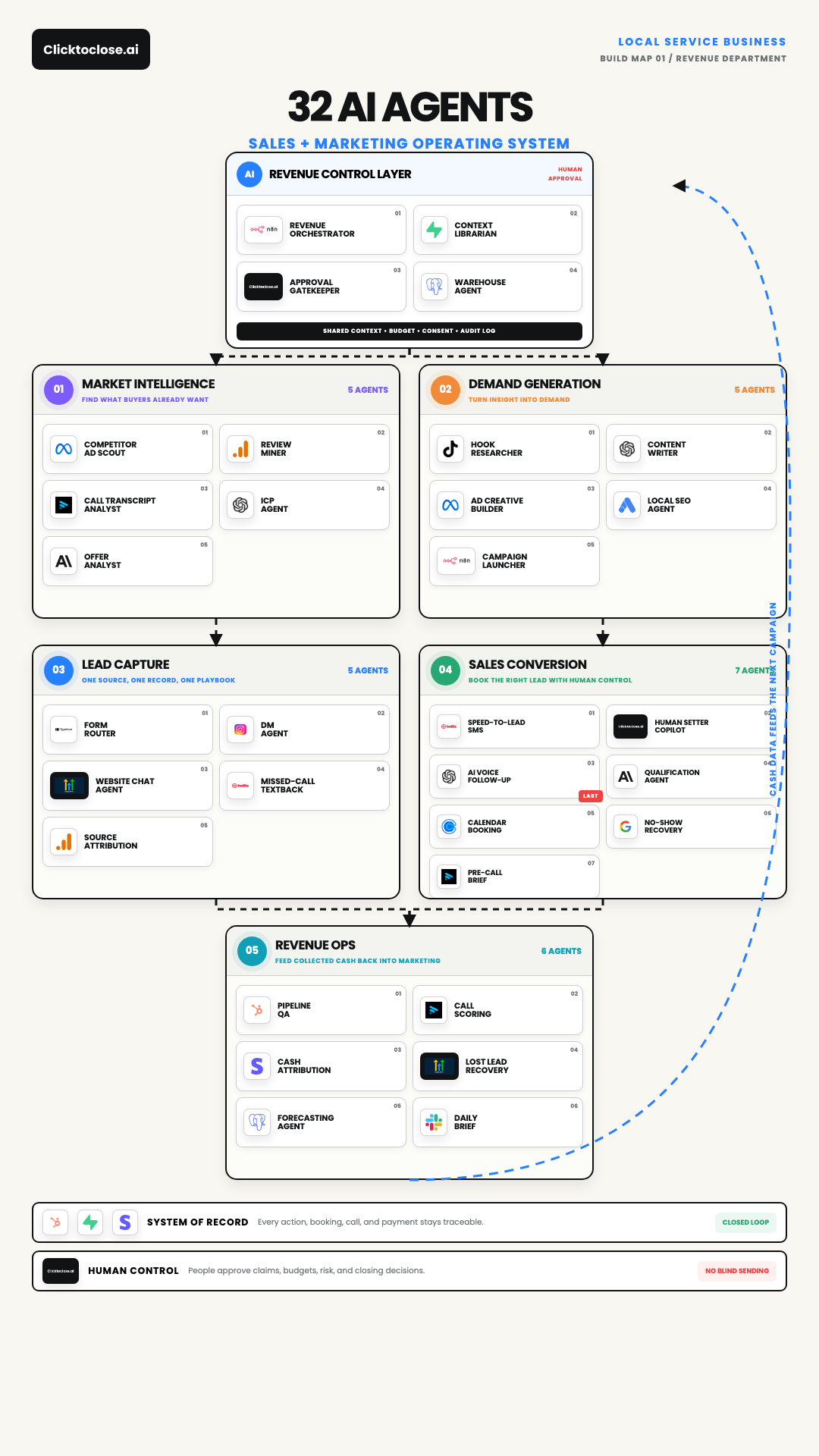
Open the full-resolution 32-agent system map
What the system is built to do
The map covers one closed revenue loop:
- Study the market and identify what buyers already want.
- Turn that insight into ads, content, local SEO, landing pages, and email.
- Capture each lead with its source and consent record.
- Help a human setter start and manage the sales conversation.
- Join activity, bookings, calls, and collected cash.
- Feed the useful result back into the next campaign.
The system has 32 named agents. Each agent owns a narrow job. Four agents sit in the control layer. The other 28 agents sit inside five operating departments.
The goal is not to turn on 32 prompts at once. The goal is to make each handoff clear before adding more automation.
The four-agent control layer
The control layer keeps the departments aligned.
Revenue Orchestrator
The Revenue Orchestrator decides which agent should act next. It does not write every ad or answer every lead. It routes work, checks the business rules, and records the result.
Context Librarian
The Context Librarian maintains the shared facts that every department can use. That includes the offer, ideal customer profile, approved claims, common objections, brand rules, and current campaign context.
Without shared context, each agent creates its own version of the business. That is how automated content and sales messages drift.
Approval Gatekeeper
The Approval Gatekeeper pauses work that needs a person. A human should approve claims, budgets, risk, exceptions, and closing decisions. The agent manages the queue and records the decision. It does not replace the decision maker.
Warehouse Agent
The Warehouse Agent keeps the analysis layer current. It joins the stable identifiers that connect a lead, campaign, conversation, booking, call, payment, and refund.
Department 1: Market intelligence
Five agents build the market brief:
- Competitor Ad Scout
- Review Miner
- Call Transcript Analyst
- ICP Agent
- Offer Analyst
These agents collect useful language from real market signals. They look for repeated pains, desired outcomes, objections, hooks, offers, and proof.
The output is not a pile of scraped text. It is a short, versioned market brief with source links and an owner. Demand generation should use that brief instead of guessing what buyers care about.
Department 2: Demand generation
Five agents turn the market brief into campaigns:
- Hook Researcher
- Content Writer
- Ad Creative Builder
- Local SEO Agent
- Campaign Launcher
The agents can prepare Meta and Google ads, short-form content, local search pages, landing pages, and email campaigns. A human approves the claim and budget before anything goes live.
This department should preserve the link between the source insight and the final asset. If an ad uses an objection found in a sales call, the team should be able to trace that decision.
Department 3: Lead capture
Five agents create one clean inbound path:
- Form Router
- DM Agent
- Website Chat Agent
- Missed-Call Textback
- Source Attribution
The capture layer receives leads from Meta, Google, Instagram, the website, forms, and missed calls. It removes duplicates, checks consent, preserves the source, and selects the right playbook.
A handoff is complete when the system can answer four questions:
- Who is this person?
- Where did the lead come from?
- Can the business contact the lead through this channel?
- Who owns the next action?
Department 4: Sales conversion
Seven agents support the sales team:
- Speed-to-Lead SMS
- Human Setter Copilot
- AI Voice Follow-Up
- Qualification Agent
- Calendar Booking
- No-Show Recovery
- Pre-Call Brief
The human setter, AI SMS, and AI voice are one coordinated system. AI SMS helps the setter respond and follow up. The human setter owns the conversation. AI voice comes last for leads who do not reply through the earlier paths.
That order matters. A prospect should not receive an AI call while a human is already speaking with them. A booked lead should leave the prospecting path. An opt-out should stop the contact covered by that request.
The Pre-Call Brief gives the closer the source, offer, conversation summary, objections, and next best questions. It should link back to the original records instead of hiding them behind an AI summary.
Department 5: Revenue Ops
Six agents close the loop:
- Pipeline QA
- Call Scoring
- Cash Attribution
- Lost Lead Recovery
- Forecasting Agent
- Daily Brief
Revenue Ops joins ad spend to the rest of the path. It checks whether the lead reached the CRM, whether the meeting happened, whether the sale closed, and whether cash was collected.
Call scores and forecasts are signals. Managers still need the recording, the source data, and the reason behind each result.
The useful outputs go back to the shared context layer. If one objection keeps appearing in qualified calls, Market Intelligence and Demand Generation should see it. If one ad produces cheap leads but little collected cash, the system should not treat that ad as a winner.
The tool logos are connection points
The logos in the map show where the agents can connect. They do not mean every business needs every platform.
For example:
- Meta, Google Ads, Instagram, TikTok, YouTube, and LinkedIn can create demand or inbound activity.
- HighLevel, HubSpot, Typeform, Twilio, Gmail, and Calendly can connect capture and follow-up.
- OpenAI, Claude, n8n, Supabase, PostgreSQL, Fathom, Slack, Stripe, and ClickToClose.ai can connect reasoning, routing, storage, review, and measurement.
Choose one system of record for each type of fact. Do not let two tools both claim to be the final source for lead ownership, consent, booking status, or collected cash.
A safer build order
Build the operating system in this order:
- Define the stable lead, campaign, booking, call, and payment identifiers.
- Map the current handoffs and name one owner for each next action.
- Create the shared context layer with approved claims and business rules.
- Connect one inbound source to the sales conversion path.
- Add human approval and a no-send test path.
- Join the outcome to collected cash.
- Add the feedback loop only after the records reconcile.
- Expand to more channels and agents one controlled use case at a time.
Test each step with a representative record. A successful API response is not enough. Verify the user-visible message, the CRM owner, the booking, the payment match, and the final report when those outcomes are part of the flow.
Use the map as a design review
Start with one real lead. Trace that lead across the five departments. Mark every place where the source, consent, owner, or next action becomes unclear.
That first unclear handoff is the place to work on before adding another agent.
If you want the full map and build order, comment PIPELINE on the reel and follow @antoniorevenue so the DM can reach you.
If you want help designing this around your current sales stack, book a system review.