Offer ideas become expensive guesses when buyer evidence, delivery capacity, proof, and pricing live in separate conversations. The fix is not more messages or more dashboards. The fix is one controlled workflow with a clear owner at every handoff.
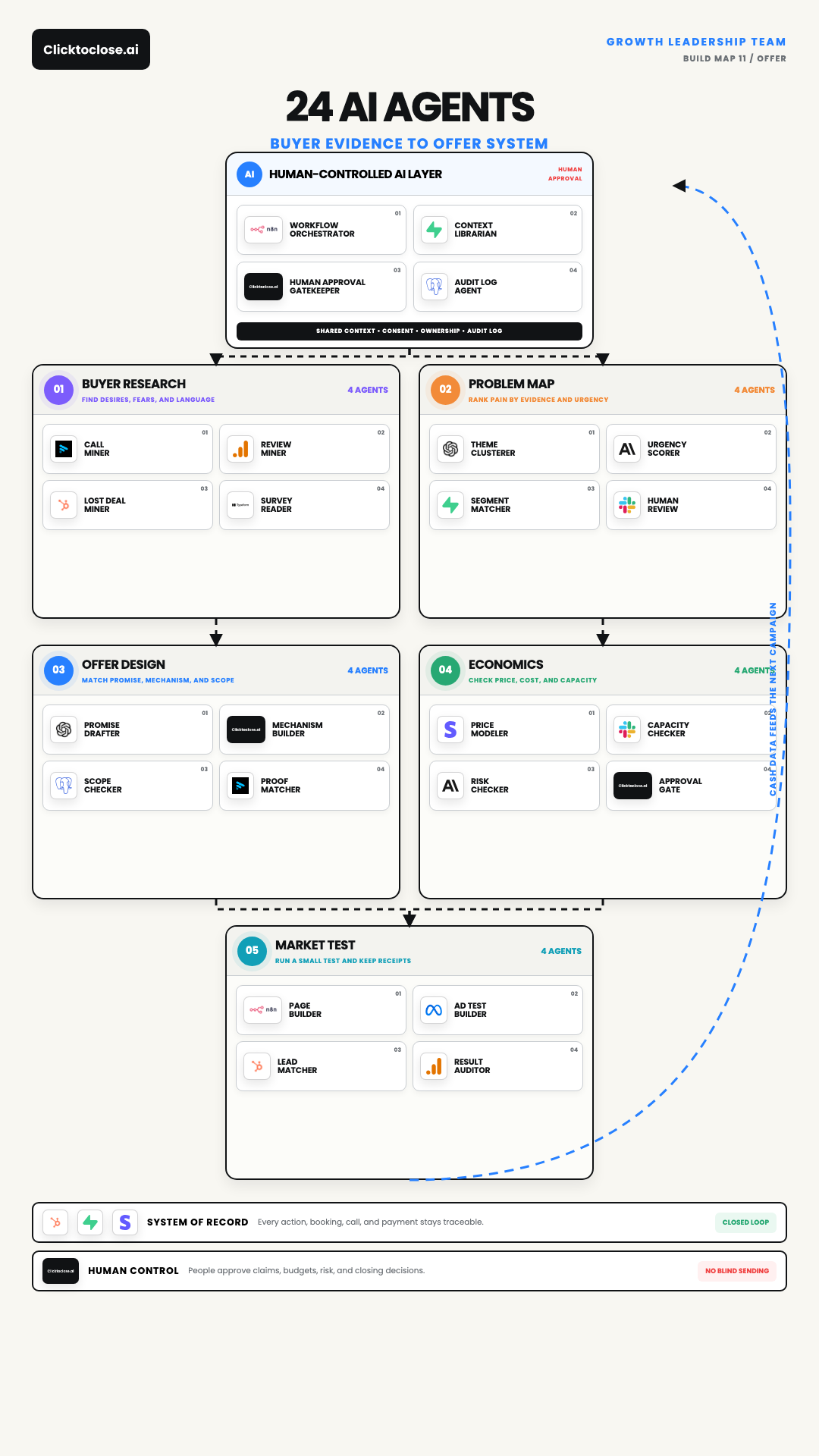
This guide breaks the Buyer Evidence to Offer System into 24 agents. Four agents control the system. Five departments do the work. The labels are roles, not a recommendation to buy 24 separate tools. One workflow can perform several roles when the boundaries are clear.
What the control layer does
The control layer keeps the workflow safe and readable. The orchestrator moves work between steps. The context librarian holds the trusted record. The human approval gate stops claims, consent decisions, budget changes, and judgment calls. The audit agent records what happened and why.
A useful rule is simple: an AI agent may prepare a decision, but it should not approve its own risky action.
1. Buyer Research
The goal is simple: find desires, fears, and language. This step should produce a visible record that the next owner can verify.
- Call Miner: Handles one clear part of the handoff with Fathom in the visible tool stack.
- Review Miner: Handles one clear part of the handoff with Googleanalytics in the visible tool stack.
- Lost Deal Miner: Handles one clear part of the handoff with Hubspot in the visible tool stack.
- Survey Reader: Handles one clear part of the handoff with Typeform in the visible tool stack.
Do not move forward when the required identity, permission, owner, or source record is missing. Route the exception to a person instead.
2. Problem Map
The goal is simple: rank pain by evidence and urgency. This step should produce a visible record that the next owner can verify.
- Theme Clusterer: Handles one clear part of the handoff with Openai in the visible tool stack.
- Urgency Scorer: Handles one clear part of the handoff with Anthropic in the visible tool stack.
- Segment Matcher: Handles one clear part of the handoff with Supabase in the visible tool stack.
- Human Review: Handles one clear part of the handoff with Slack in the visible tool stack.
Do not move forward when the required identity, permission, owner, or source record is missing. Route the exception to a person instead.
3. Offer Design
The goal is simple: match promise, mechanism, and scope. This step should produce a visible record that the next owner can verify.
- Promise Drafter: Handles one clear part of the handoff with Openai in the visible tool stack.
- Mechanism Builder: Handles one clear part of the handoff with C2C in the visible tool stack.
- Scope Checker: Handles one clear part of the handoff with Postgresql in the visible tool stack.
- Proof Matcher: Handles one clear part of the handoff with Fathom in the visible tool stack.
Do not move forward when the required identity, permission, owner, or source record is missing. Route the exception to a person instead.
4. Economics
The goal is simple: check price, cost, and capacity. This step should produce a visible record that the next owner can verify.
- Price Modeler: Handles one clear part of the handoff with Stripe in the visible tool stack.
- Capacity Checker: Handles one clear part of the handoff with Slack in the visible tool stack.
- Risk Checker: Handles one clear part of the handoff with Anthropic in the visible tool stack.
- Approval Gate: Handles one clear part of the handoff with C2C in the visible tool stack.
Do not move forward when the required identity, permission, owner, or source record is missing. Route the exception to a person instead.
5. Market Test
The goal is simple: run a small test and keep receipts. This step should produce a visible record that the next owner can verify.
- Page Builder: Handles one clear part of the handoff with N8N in the visible tool stack.
- Ad Test Builder: Handles one clear part of the handoff with Meta in the visible tool stack.
- Lead Matcher: Handles one clear part of the handoff with Hubspot in the visible tool stack.
- Result Auditor: Handles one clear part of the handoff with Googleanalytics in the visible tool stack.
Do not move forward when the required identity, permission, owner, or source record is missing. Route the exception to a person instead.
Build order
- Pick one real record and trace it from the first source event to the final outcome.
- Define the trusted identifier, consent state, owner, next action, and service level.
- Add one assisted action that a person can review.
- Write a receipt after every handoff. A receipt can be a CRM event, task, booking, call, or payment match.
- Test a missing-data path and a provider-failure path before sending anything to a real lead or customer.
- Measure the outcome that matters. Do not treat a sent message or API success as a booked call, sale, or retained customer.
Use the map as an audit
Take one recent successful record and one failed record. Mark the first step where source, identity, permission, ownership, timing, or outcome became unclear. Fix that step before adding another agent. This keeps the build tied to a business need instead of a tool demo.
Get the full map
If you want the map, tool stack, and build order, comment OFFERLAB on the reel and follow @antoniorevenue so the DM can reach you.