Most businesses do not need another lead source first. They need to stop losing the leads they already paid for.
The usual problem is not one broken tool. It is a broken handoff. A form submits, but no owner gets assigned. A prospect replies, but the answer sits in the wrong inbox. A sale closes, but the payment never reaches the commission ledger. Each gap looks small by itself. Together, they make the whole revenue path hard to trust.
This AI revenue recovery system maps that path from the first form to collected cash. It has 30 modules across six departments. The goal is not to install every tool. The goal is to find the first handoff that fails, give it one owner, and prove the fix with real records.
Open the full-resolution system map
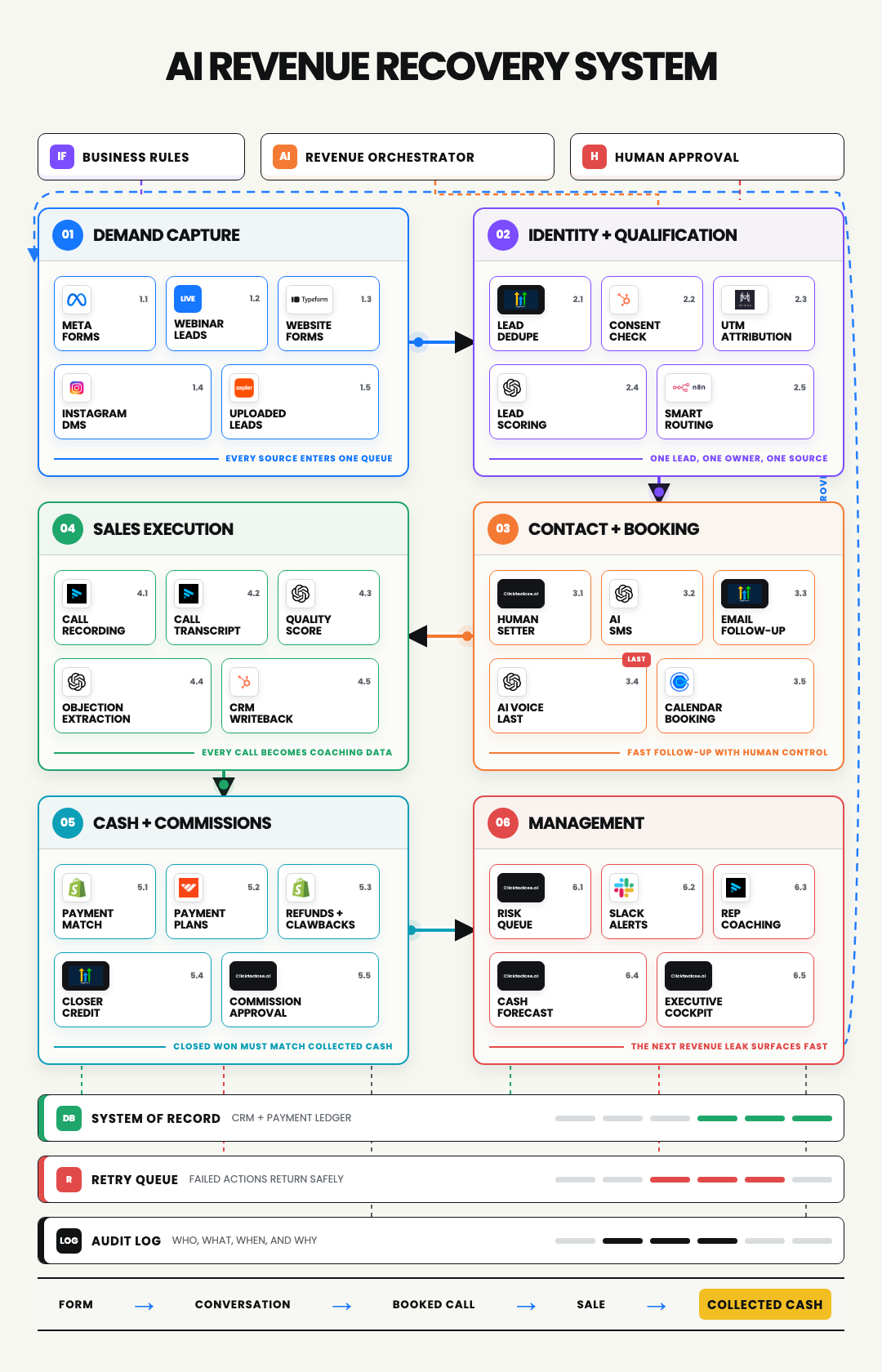
What the blueprint covers
The map follows one lead through the business:
- Demand capture
- Identity and qualification
- Contact and booking
- Sales execution
- Cash and commissions
- Management
Three controls sit above the workflow: business rules, the revenue orchestrator, and human approval. Three rails sit below it: the system of record, the retry queue, and the audit log.
That structure matters. AI can move work faster, but it should not decide every exception on its own. The system needs rules, clear ownership, a safe failure path, and a record of what happened.
Demand capture
The first department puts every lead into one queue. Sources can include Meta forms, webinars, website forms, Instagram DMs, and uploaded lists.
The source should stay attached to the lead. Do not flatten five sources into an anonymous contact list. The business needs to know where the lead came from, when it arrived, and which consent or campaign record came with it.
The handoff is complete when the lead appears once in the system of record with a source, timestamp, and stable ID.
Identity and qualification
This department cleans the record before anyone starts selling.
It removes duplicates, checks consent, preserves attribution, scores the lead, and assigns one owner. The scoring model can use AI, but ownership cannot stay vague. A lead with three possible owners usually has no real owner.
The handoff is complete when the system can answer four questions:
- Is this one person or a duplicate?
- Can we contact them through this channel?
- Which source and campaign deserve credit?
- Who owns the next action?
Contact and booking
This is where the business turns a record into a conversation.
A human setter remains in control. AI text, email, and voice fill the gaps around that person. The system can send a fast first response, continue a useful follow-up, and offer the correct calendar. AI voice comes last, after the human setter, AI SMS, and email paths have had their chance.
The handoff is complete when every reply changes the next action. A positive reply should not receive another cold follow-up. A booked lead should leave the prospecting sequence. An opt-out should stop all contact that the request covers.
Sales execution
Every sales call should create usable coaching data.
The system records the call, creates a transcript, scores agreed quality checks, extracts objections, and writes the useful result back to the CRM. The score should not be treated as truth by itself. Managers still need the recording and the reason behind the score.
The handoff is complete when the rep and manager can see the call, the outcome, the next action, and the coaching note in the same operating flow.
Cash and commissions
A closed deal is not the same as collected cash.
This department matches payments, payment plans, refunds, and chargebacks to the sale. It then assigns closer credit and moves commission approval through a clear review step.
The handoff is complete when the business can trace a commission line back to the person, opportunity, payment event, and approval record. If those records do not join, the commission should wait for review.
The sales operations reconciliation workflow shows how this part fits into the system ClickToClose installs.
Management
The final department turns exceptions into a daily operating list.
It surfaces risky records, sends focused alerts, helps managers coach reps, forecasts expected cash, and gives leaders one view of the next leak. The dashboard should point to action. A red number without the affected records is only decoration.
The handoff is complete when a manager can open the risk queue, see why each item is there, assign the next action, and confirm that the issue cleared.
The three controls that keep AI safe
Business rules
Business rules define what must always be true. Examples include consent limits, owner assignment, allowed follow-up windows, commission policy, and approval thresholds.
Revenue orchestrator
The orchestrator moves work between systems. It should retry safe failures, stop risky actions, and pass exceptions to a person. It should not hide errors behind a green status.
Human approval
People approve actions that carry real risk. This can include a sensitive message, a refund decision, a commission exception, or a large account change. The exact boundary depends on the business.
The NIST AI Risk Management Framework is a useful reference for defining roles, oversight, and risk controls.
The three rails underneath the workflow
System of record
Choose the database that owns each important fact. The CRM may own contact and opportunity state. The payment ledger may own collected cash. A report should join those records without pretending one system owns everything.
Review each AI provider's storage and retention terms before sending customer data. OpenAI documents its current options in the API data controls guide.
Retry queue
Failed actions need a safe place to wait. The queue should record the item, reason, attempt count, next retry, and owner. A retry should not send the same message twice or charge the same payment twice.
Audit log
Record who changed what, when it changed, and why. This makes automation easier to debug and gives managers a reliable record when a result is challenged.
How to use the map this week
Do not start by buying more tools. Start with one real lead.
- Pick a recent lead that should have become a sale but did not.
- Trace that lead from its first source record to its last known action.
- Mark the first place where ownership, timing, or data became unclear.
- Fix that one handoff.
- Run another real lead through the same path.
- Add automation only after the handoff works without guesswork.
This approach keeps the build tied to evidence. It also stops a team from automating a process it has not defined.
What to measure
Use a small set of operating checks for each handoff:
| Handoff | Basic proof |
|---|---|
| Source to CRM | One lead record, source, timestamp, consent |
| CRM to owner | One assigned owner and one next action |
| Owner to conversation | First response and reply state |
| Conversation to booking | Calendar event tied to the same lead |
| Booking to call | Recording, outcome, and next step |
| Sale to cash | Opportunity joined to payment events |
| Cash to commission | Credit, policy, and approval record |
| Exception to management | Named owner, reason, and cleared state |
The exact metrics will vary. The proof standard should not. Every number must lead back to the records that created it.
Frequently asked questions
Do I need all 30 modules?
No. The map is a reference architecture. Start with the modules needed to repair the first broken handoff. Add the rest only when the business process requires them.
Can AI run the whole system without people?
It should not. AI can classify, draft, route, summarize, and monitor. People should keep control of sensitive messages, policy exceptions, refunds, commission disputes, and other high-risk decisions.
Which CRM does this require?
The pattern is CRM-independent. The examples use common sales and marketing tools, but the operating rules matter more than the logo. The chosen systems must preserve IDs, timestamps, owners, and source records.
Where should I start if our data is messy?
Start with identity and ownership. Remove duplicates, preserve the source, and assign one owner before adding more follow-up. Faster automation will only spread unclear data faster.
What is the first success check?
Trace one real lead from the source to its current state without opening a spreadsheet to fill a missing gap. If the team can see the record, owner, next action, and outcome, the first part of the system is working.
Want this installed into your sales operation?
Bring one real lead, one recent sale, and one failed handoff. We will map the path and show you where the operating system needs to change.