Most sales teams record calls and use only a small part of what buyers say. A manager may review a few calls. A rep may write notes. Marketing may never see the objections, questions, or buying triggers inside those conversations.
This AI sales call analysis map turns the recording into a controlled feedback loop. It uses 24 narrow agents across five departments. The goal is not to let AI rewrite the sales process. The goal is to give the right person the right evidence and connect each change to a real outcome.
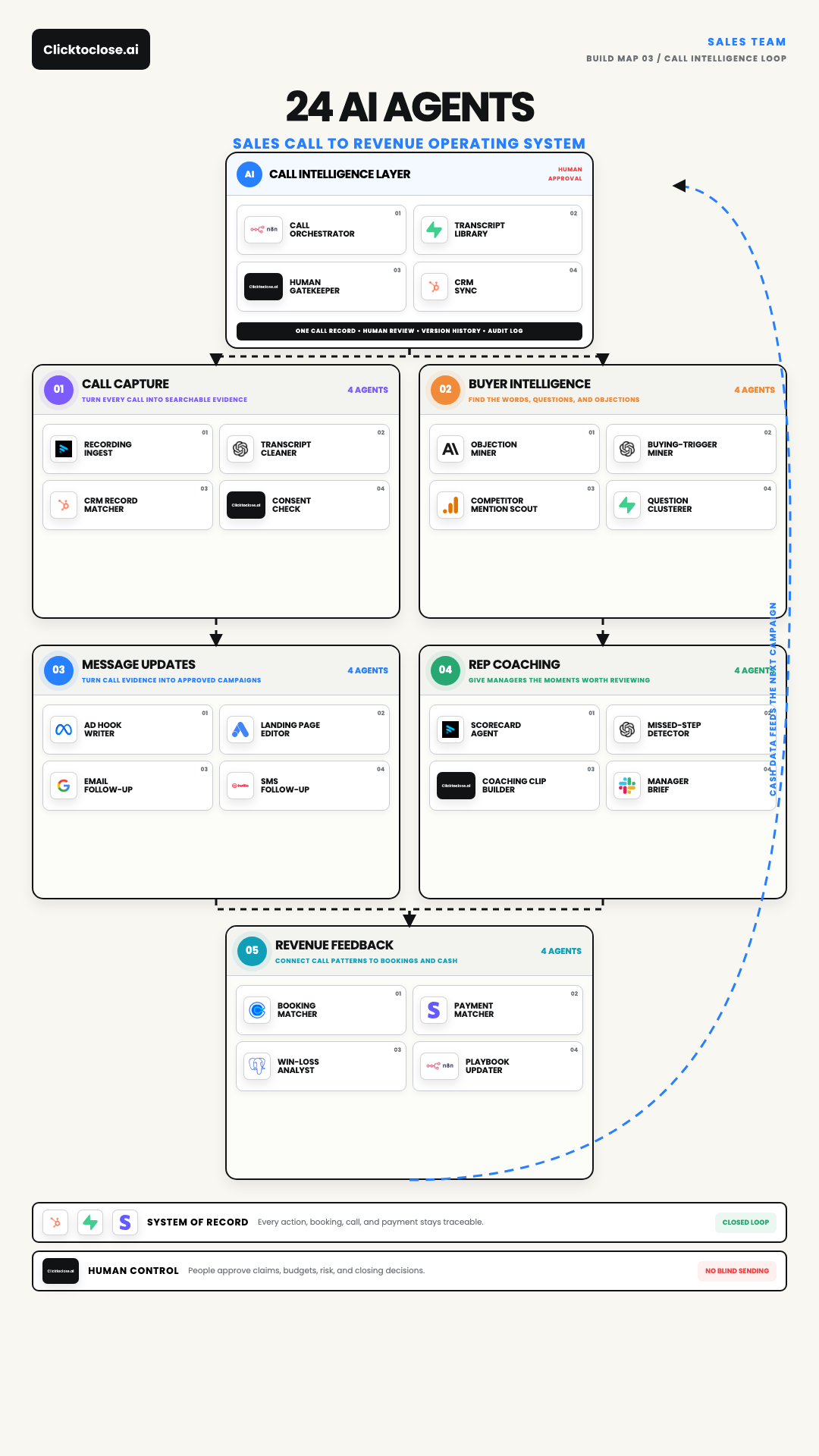
Open the full-resolution sales-call intelligence map
What a call intelligence loop should do
A useful call system has five jobs:
- Capture the recording and transcript.
- Match the call to the right CRM record.
- Find repeated buyer language with source timestamps.
- Route message and coaching changes to a person.
- Connect the call to bookings, sales, payments, and losses.
The system should never hide the original call. Every summary, score, and recommendation needs a path back to the recording and source record.
HubSpot's guide to conversation recording and transcription explains that transcripts can sync to customer records and support summaries, next steps, and other conversation intelligence features. The operating value appears when the team knows who reviews those outputs and what happens next.
The four-agent call control layer
The control layer keeps the same identity and rules across the five departments.
Call Orchestrator
The Call Orchestrator moves work after each event. A new recording can open a transcript task. A verified transcript can enter the buyer-language queue. An approved insight can become a draft test. A closed deal can return to the feedback loop.
The orchestrator should stop when the recording is missing, the contact match is weak, or the team lacks permission to process the call.
Transcript Library
The Transcript Library stores the transcript, timestamps, speaker labels, model version, and source URL. It should also store the stable call ID and contact ID.
Keep the raw source and the cleaned version. Cleaning can remove filler or fix names, but it can also change meaning. A reviewer needs the original evidence when a decision matters.
Human Gatekeeper
The Human Gatekeeper owns message changes, coaching decisions, and unusual data access. It records who approved the change, what evidence they saw, and which version moved forward.
AI can prepare options. A manager decides how to coach a person. A marketer decides whether an objection belongs in an ad. A sales leader decides whether the sales process needs to change.
CRM Sync
CRM Sync connects the call to the contact, opportunity, rep, campaign, and next action. The match needs a stable rule. A phone number or email can help, but the final link should use the CRM's record ID.
Department 1: Call capture
Four agents turn the conversation into usable evidence:
- Recording Ingest
- Transcript Cleaner
- CRM Record Matcher
- Consent Check
Recording Ingest saves the source URL and event time. Transcript Cleaner produces searchable text without replacing the raw recording. CRM Record Matcher links the correct person and deal. Consent Check applies the rules for the call type and location.
Recording rules can vary by area and use case. HubSpot's call recording best practices tells users to review the laws that apply to their area. The system should store the applicable policy and create an exception when the rule is unclear.
After the next supported call, verify that the recording, transcript, and CRM association are all visible. An integration status alone does not prove the transcript reached the correct buyer record.
Department 2: Buyer intelligence
The Buyer Intelligence department looks for four kinds of evidence:
- Objection Miner
- Buying-Trigger Miner
- Competitor-Mention Scout
- Question Clusterer
Each output should include the call ID, speaker, timestamp, and short excerpt. That makes the result reviewable. It also reduces the risk of turning one unusual comment into a market-wide claim.
Frequency is useful, but context matters. Ten mentions of price may mean the offer feels expensive. They may also mean the rep introduces price too early. A person should listen to the examples before choosing the cause.
Group related questions and objections, but keep the source list. The team needs to know whether the pattern came from qualified buyers, unqualified leads, won deals, or lost deals.
Department 3: Message updates
Four agents turn approved patterns into drafts:
- Ad Hook Writer
- Landing Page Editor
- Email Follow-Up
- SMS Follow-Up
The agents use the buyer's language to prepare a test. They do not publish on their own. A person reviews the claim, offer, audience, channel, and source evidence.
One insight should create one clear test. If buyers repeatedly ask how implementation works, the team might add one implementation section to the landing page. It should not change the ad, page, email, script, and price at the same time. That would make the result hard to interpret.
Every approved asset should link back to the call pattern that caused the change. It should also keep a version number so the team can tell which message was active when a lead entered.
Department 4: Rep coaching
Four agents help managers focus their review:
- Scorecard Agent
- Missed-Step Detector
- Coaching Clip Builder
- Manager Brief
The Scorecard Agent applies the documented process. The Missed-Step Detector finds moments that may need review. The Coaching Clip Builder saves the relevant section. The Manager Brief gives the manager the clip, evidence, and suggested question.
The manager owns the coaching decision. Automated scores can be wrong because of a bad transcript, unclear speaker label, or an exception that the process did not cover.
HubSpot's guide to reviewing call recordings and transcripts shows how reviewers can add notes, timestamped comments, and clips. That is a useful model for evidence-led coaching. The reviewer sees the exact moment instead of trusting a summary alone.
Keep the coaching loop small. One clip, one behavior, and one next action are easier for a rep to use than a long automated report.
Department 5: Revenue feedback
The last department connects call patterns to business outcomes:
- Booking Matcher
- Payment Matcher
- Win-Loss Analyst
- Playbook Updater
The Booking Matcher connects the call to an appointment. The Payment Matcher connects the buyer and sale to collected cash. The Win-Loss Analyst separates won, lost, open, refunded, and unknown outcomes. The Playbook Updater prepares a controlled change for review.
Do not use pipeline value as collected cash. Do not treat every booked call as a sale. Keep the eligible call set and each outcome visible.
The ClickToClose high-ticket sales analytics workspace is designed around that call-to-cash connection. A manager should be able to move from the summary back to the call, booking, opportunity, payment, and owner.
A practical build order
Start with one team and one call type.
- Define the call ID, contact ID, opportunity ID, and owner.
- Confirm the recording and consent rules.
- Ingest the recording and preserve the source.
- Create the transcript with timestamps and speaker labels.
- Match the transcript to the CRM record.
- Extract one pattern with links to the source moments.
- Route that pattern to one human reviewer.
- Create one approved message or coaching test.
- Join the call to the booking and payment events.
- Compare the result with the eligible call group.
Use a no-write test before the system changes a CRM record, publishes copy, or sends a message. Then verify the exact record after the write. A successful API response does not prove that the right rep, buyer, or campaign changed.
How to use the map
Choose five recent calls: one win, one loss, one no-show, one open deal, and one unclear outcome. Trace each call across the map.
Ask these questions:
- Can the team open the original recording?
- Is the transcript attached to the right person?
- Does each insight include a timestamp?
- Did a person approve the message or coaching action?
- Can the team identify which version ran?
- Is the booking tied to the same call?
- Is the payment collected, refunded, or still unknown?
The first question the system cannot answer is the first repair. Do not add more analysis until the evidence and ownership are clear.
If you want the full map, prompts, and build order, comment CALLS on the reel and follow @antoniorevenue so the DM can reach you.
If you want help connecting this loop to your current sales stack, book a demo.